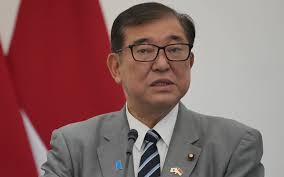
On September 27th 2024, a member of Japan’s ruling Liberal Democratic Party (LDP), Shigeru Ishiba, boldly proposed an “Asian version of NATO“. This proposal went largely unnoticed by the media until Ishiba was sworn in as Prime Minister just days later on October 1st. While the original Trans-Atlantic NATO grouping successfully balanced the erstwhile Soviet Union and endures till this day, many obstacles remain for a similar grouping to emerge in Asia.
Intriguingly, successive Japanese leaders have perceived an increasingly ominous outlook for Asia, with Japan even reinterpreting its post-war constitution in 2015 in response to a rising and more territorially assertive China. In 2014, then Japanese PM Shinzo Abe even likened the situation in Asia to that in Europe before the First World War. Significantly, Mr. Abe noted that prior to that conflict, Britain and Germany had actually had a strong trading relationship. Yet this did not avert the conflict he stressed. This was seen as a veiled reference to China, which was (and still is) Japan’s largest trading partner but with whom tensions have risen, particularly over the disputed Senkaku islands.
Under Abe and his successor, Fumio Kishida, Japan would increasingly view the South China Sea and Taiwan as intrinsically linked to its own national security. In fact, Japanese officials have increasingly alluded to the need to aid Taiwan in a potential conflict, drawing the ire of Beijing. Japan’s westernmost island of Yonaguni is also only 70 miles from Taiwan roughly. As early as 2015, Tokyo had also commenced unilateral patrols in the South China Sea, where the bulk of its energy supplies and trade transit. Significantly, Beijing has been undertaking a large-scale campaign of island-building in that sea, roughly 90% of which it claims. Tokyo has also stepped up defence cooperation with Manila, dispatching fighter aircraft and self-defence forces personnel to Filipino soil in the time since.
In August 2022, Beijing conducted large-scale military exercises in response to the US House Speaker’s trip to Taiwan. Six Chinese ballistic missiles landed in waters near Japan’s southwestern islands, one of them near Yonaguni, and five others within Japan’s exclusive economic zone (EEZ). This was regarded as a warning to Tokyo to stay out of the China-Taiwan dispute.
Upon becoming Prime Minister in October 2024, Ishiba wasted little time in declaring “today’s Ukraine could be tomorrow’s East Asia“. Not only does Ishiba share his predecessors’ view of an increasingly tense regional situation, he also seemed ready to endorse a more comprehensive multilateral security architecture in Asia. His prior proposal for an “Asian NATO” began receiving significant media attention domestically and internationally. Incidentally, both Japan (and South Korea) have been drawing closer to the NATO grouping, with then PM Fumio Kishida even attending a NATO summit for the first time in June 2022.
Perhaps predictably, Ishiba’s proposal evoked cynicism in Chinese media (it was likened to a “daydream” by the state-run Global Times). The response from China’s foreign ministry was also lukewarm. However, the biggest obstacle confronting a plausible “Asian NATO” might not be China, whose objections Tokyo has progressively defied since it commenced a remilitarisation in 2015.
Until it reinterpreted its post-war constitution that year, Japan was significantly constrained in helping allies in the event of a conflict they were involved in. Even at the time, the changes were seen as controversial in Japan, whose public has been wary of getting embroiled in another conflict since the devastating Second World War. A new multilateral alliance and obligations as part of it could thus further stoke domestic concerns. In an exchange with opposition party leaders in parliament, Ishiba even conceded that an “Asian NATO” “cannot be launched overnight“.
Furthermore, the US, Japan’s main ally and security guarantor, has had a strong preference for bilateral alliances traditionally (outside of the NATO framework). With the disbandment of SEATO following the April 1975 Fall of South Vietnam and that of CENTO following the 1979 Iranian Revolution, Washington realised bilateral alliances were easier to sustain in Southeast Asia and the Middle East respectively. This effectively prevented the emergence or preservation of further multilateral alliances in the NATO mould (one exception proved to be ANZUS, a trilateral alliance between the US, Australia, and New Zealand).
In a further blow, Indian External Affairs Minister, S. Jaishankar, flatly rejected the “Asian NATO” call by Ishiba. For years prior, Tokyo and New Delhi had been deepening defence cooperation, particularly in the maritime realm, in response to a perceived common threat from a rising China. As far back as 2012, Shinzo Abe had even touted the concept of “Asia’s Democratic Security Diamond” – comprising democracies such as Japan, the US, Australia, and India. Over time, the QUAD or Quadrilateral Security Dialogue between these four nations took shape (despite objections from Beijing which denounced “exclusive cliques“). Nevertheless, New Delhi has historically tended to reject formal alliances and Jaishankar has himself likened the QUAD to a grouping rather than a formal alliance.
Furthermore, there is also the prospect of reticence from members of ASEAN (Association of Southeast Asian Nations). Many ASEAN members have high economic integration with China, which has been the bloc’s largest trading partner since 2009. Indeed, ASEAN members have already been walking a fine line between the US and China as geopolitical tensions have risen and have been reluctant to pick a side. Even if keen to boost security linkages, many ASEAN states would likely prefer to do so on a bilateral rather than a multilateral basis.
Given the myriad obstacles, it was not long before ministers in Ishiba’s cabinet clarified their country was not currently pursuing the PM’s call for an “Asian NATO”. However, the country’s foreign minister maintained it could still be an “idea for the future“. A prominent Japanese tabloid also reported Ishiba would avoid an “Asian NATO” pitch during an October 6th to 11th summit of the Association of Southeast Asian Nations (ASEAN) and partner countries (in what was perhaps a tacit admission of the concept’s unpopularity regionally).
Hence, not only does an “Asian NATO” remain an idea for the future, it still has few takers within Asia itself notably. Going further, regional dynamics such as India’s historic rejection of formal alliances as well as the traditional US preference for bilateral alliances in the Asia-Pacific may also prove to be impediments to the formation of a truly multilateral alliance in Asia. Rather, so-called “minilateral” groupings such as the recently formed AUKUS (between Australia, the UK, and the US) are more plausible for the time being.
 Status Quo Asia
Leave a comment