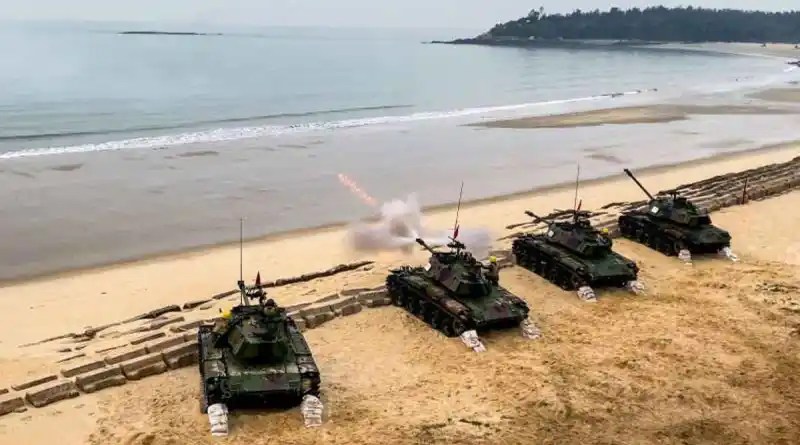
Since the retreat of Nationalist forces to Taiwan during the Chinese Civil War, the island has been the subject of a bitter territorial dispute, with Beijing considering it a “renegade province” awaiting reunification with the mainland. With the Chinese Civil War drawing to a close in 1949, the Chinese Communist Party (CCP) under Mao Zedong declared the People’s Republic of China (PRC) on the mainland on October 1st. Yet, while the CCP secured the overwhelming share of China’s territory, the resilience of the Nationalists in Taiwan proved to be a sore point. In fact, the Nationalists wasted little time establishing the Republic of China (ROC) government on the island, which laid claim to all of China’s territories – including the mainland in its entirety. In doing so, it began competing with the PRC government to be the legitimate representative of the Chinese people. Despite initially holding China’s seat at the United Nations, the ROC was replaced by the much larger PRC as a result of a UN General Assembly resolution in 1971 – a landmark development. In the years since 1971, the trend of countries cutting diplomatic ties with the ROC government to instead recognise the PRC government has only picked up, resulting in increasing diplomatic isolation of the former. Observers argue that this steady erosion of Taiwanese sovereignty, while the mainland’s own power grows, has compelled the latter to take a long view towards reunification post-1971. Yet, it is also pertinent to consider why the mainland refrained from any serious attempt to retake Taiwan’s main island from the end of the Chinese Civil War in 1949 up till the Republic of China’s ouster from the United Nations.
On October 1st 1949, when the People’s Republic of China was declared, large swathes of southern China remained under Nationalist control. By this time, however, the Nationalists had lost the initiative in the Chinese Civil War that had lasted years and were being routed by the Communists on all fronts on the mainland. In the view of the CCP, removing the last vestiges of Nationalist resistance on the mainland – as well as on Taiwan – fit into the logical progression of ending the civil war.
After the mainland was secured in its entirety, the Communists set their sights on Hainan, an island still defended by the Nationalists. Both sides recognised the strategic importance of securing Hainan. In April 1950, the PLA landed on Hainan and proceeded to capture the island in its entirety. This greatly emboldened the CCP, which now believed an invasion of the main island of Taiwan could likewise be achieved. Even before Hainan had been captured, Mao Zedong asked General Su Yu, “What are the issues or problems related to seizing Taiwan?”
However, Taiwan’s geography proved to be a pointed challenge to any landing force from the mainland. With its main island 100 miles away, Taiwan is significantly harder to reach than Hainan. The PRC also lacked a sufficiently large flotilla to transport its troops across the straits at the end of the civil war. It was impoverished at the time and lacked the resources to build a modern flotilla. Complicating matters was the fact that the waters in the Taiwan Strait are among the choppiest in the world. So much so, many boats carrying fleeing Nationalists from the mainland from 1948 onwards had sunk while attempting to make the journey.
Furthermore, even as the Nationalists retreated from the mainland, they retained more air and naval assets than the Communists. Despite its impressive string of victories on the mainland, the People’s Liberation Army (PLA) was largely a peasant army at the time and was not adequately prepared to undertake an amphibious invasion, which is an operationally complex task. The Nationalists’ air superiority over the Taiwan Straits may also have dissuaded the PLA from attempting an invasion. Lastly, while the Nationalists had been defeated in Hainan, tens of thousands of their battle-hardened troops had managed to retreat to Taiwan by boat, giving a boost to their forces there.
Both Mao and General Su Yu recognised time was of the essence and the mainland’s window of opportunity was closing. Any invasion of Taiwan would need to happen soon if the Communists were to retain the initiative. Perhaps unsurprisingly, the Nationalists were already busy garrisoning the beaches on Taiwan in order to deter a landing force. Also notable was the fact that the United States initially refrained from helping the Nationalists to the extent they had hoped for. While the United States had earlier dispatched advisors to the mainland to help the Nationalists in the Chinese Civil War, it refrained from getting involved in the conflict directly, which it regarded as a civil war among the Chinese essentially. In fact, it even spearheaded a meeting between Mao and Chiang Kai-shek – perhaps naively – in 1945 in the hope of obtaining a peaceful resolution. Even as the Nationalists retreated to Taiwan, US help was not forthcoming. This inferably gave the Communists a golden opportunity to attempt capturing Taiwan without risking the intervention of an outside power.
Yet despite its reluctance to intervene directly in the Chinese Civil War, the US was notably quick to recognise the Republic of China government on Taiwan instead of the newly established PRC government on the mainland. From 1950 onwards, the US also revised its policy and began providing a defensive umbrella to Taiwan, helping deter an invasion from the mainland from then onwards. This change in approach can be attributed to several factors.
Then US President Harry Truman was facing widespread criticism in government circles for failing to prevent the “Loss of China” to the Communists, as it was seen. With North Korea’s invasion of South Korea in June 1950, the perceived threat of communist expansion grew, as did fears that other entities would become overrun in time, in what became known as the “domino theory”. Truman felt compelled to draw a line with the deployment of US naval forces to the Taiwan Strait. Significantly, the presence of a technologically superior force in the straits effectively halted any CCP plans to retake Taiwan.
Problematically, however, Mao perceived the US Navy patrols in the Taiwan Straits as evidence of a broader US strategy to contain mainland. This perception strengthened as US forces advanced northward up the Korean Peninsula to reach the Chinese border by October 1950. With Mao alarmed by the growing US presence around the mainland, the PLA dispatched its more experienced troops towards the Korean front in preparation for an intervention against the US forces. For the next nearly three years, any invasion attempt of Taiwan was put on hold as bitter fighting ensued in Korea. In the end, China was able to push back US and South Korean forces to the 38th parallel, ensuring a stalemate.
With the signing of an armistice in 1953, the mainland’s attention was no longer consumed by the Korean conflict, which had proved very draining. However, the ROC government had used the time bought by the Korean War to garrison its possessions in the Taiwan Straits, making them harder to invade. Both sides continued to exchange threats with the ROC even attempting to insert guerrilla forces on the mainland via its outlying possessions.
In August 1954, Taiwan dispatched tens of thousands of troops to Kinmen and Matsu and commenced the construction of defensive structures. This move triggered a strong reaction from the mainland with Zhou Enlai calling for the “liberation” of Taiwan. On September 3 the mainland responded with an artillery barrage on Kinmen. The ensuing conflict lasted until May 1955 and became known as the First Taiwan Straits Crisis. In this conflict, the PRC made clear territorial gains, capturing the Yijiangshan Islands and also occupying the Dachen islands, which Taiwan was forced to abandon in order to defend its other possessions. However, the PRC did not attempt an invasion Taiwan’s main island.
It is plausible that strengthening of US defense commitments to Taiwan may have deterred the mainland from advancing further or attempting to capture Taiwan’s main island. While the commencement of US Navy patrols in 1950 had placed Taiwan under an effective defensive umbrella, the US still had no formal obligation defend the island. This changed with the signing of a mutual defense treaty against the backdrop of the First Taiwan Straits Crisis. Despite a recommendation from the Joint Chiefs of Staff to use nuclear weapons against China in September 1954, President Eisenhower was resistant to the idea. Instead, on December 2nd 1954, the US and Taiwan agreed to the “Sino-American Defense Treaty”.
However, the treaty did not cover possessions in the Taiwan Strait despite ROC government’s requests, reflecting US reluctance to become directly involved in a cross-straits conflict. Incidentally, the PLA captured the Yijiangshan Islands from Taiwan in January 1954. Under US pressure, Taiwan would also abandon the Dachen islands to the mainland, with the US helping facilitate an evacuation from there.
In 1958, further fighting broke out in what became known as the Second Taiwan Strait Crisis. The island of Kinmen and the Matsu Islands, which were administered by the ROC government, were subject to shelling by the PRC. A naval battle also occurred around Dongding Island where the ROC Navy successfully repelled an attempted amphibious landing by the PLA Navy.
As time went on, however, the PRC government’s need to resort to military force likely diminished as more countries began recognising it as the legitimate representative of the Chinese people in place of the ROC government on Taiwan, which lost diplomatic allies steadily. In 1971, a landmark vote was held in the United Nations General Assembly to determine which government would represent China at the organisation. From the end of the Chinese Civil War in 1949 up till 1971, the ROC had been China’s formal representative at the UN and even held one of the five permanent seats in the powerful Security Council. Despite firm American support for the ROC retaining its seat, many countries had long questioned the utility of recognising the entity at the expense of the mainland, a much larger entity, whose absence at the UN was glaring. The result was that a decisive majority of countries – 75 in total – voted in favour of UNGA resolution 2758 – “Restoration of the lawful rights of the People’s Republic of China in the United Nations” – paving the way for the PRC to replace Taiwan officially at the United Nations Security Council (UNSC).
With its growing diplomatic victories, it is plausible the mainland did not feel as strong a need to ensure reunification through military means. In fact, the pressures to ensure reunification may have been greatest in the 1949 -1971 period: Taiwan’s outsized recognition relative to its demographic had helped burnish its claim of being the legitimate representative of the Chinese people. This ceased after the 1971 UNGA vote: not only was Taiwan sidelined from the UN – the leading intergovernmental organisation – the mainland gained prestige as a veto-wielding member of the Security Council, affording it much power. The question of who was the legitimate government of China had largely become an effective non-issue.
 Status Quo Asia
Leave a comment