On 20th October 1962, China’s People’s Liberation Army (PLA) launched a massive surprise attack across the Himalayas along two separate fronts, crushing Indian troop positions in a brief but bloody war. In the western sector, the PLA annexed the 38,000 square kilometer Aksai Chin plateau. And in the eastern sector, thousands of kilometers away, the PLA overran swathes of India’s Arunachal Pradesh. However, in a surprise move, Beijing would withdraw from Arunachal Pradesh after declaring a unilateral ceasefire. The reasons for this are still debated today. Notably, the war, which was fought at high altitudes and in harsh conditions, lacked the involvement of either country’s air force. Yet one would be mistaken to think that fighting occurred between soldiers alone.
In the closing days of the war, an increasingly desperate India airlifted six AMX-13 light tanks to the Chushul airstrip in the western sector. The move was ambitious and unprecedented as the elevation of the airstrip was approximately 14,000 feet. Although the war proved forgettable for New Delhi on the whole, the tanks performed satisfactorily and were “critical in stopping the Chinese advance” until hostilities ceased on 21st November. Indian sources claim that without these tanks, the PLA, which had advanced through an area known as the Spanggur Gap, would have captured Chushul.
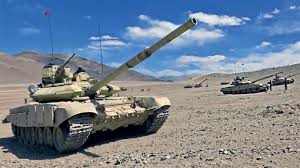
Fast forward over sixty years and tanks are now regularly deployed by both sides along the contested Himalayan border. The Ladakh region (which includes Aksai Chin in New Delhi’s definition) is interspersed with flat terrain conducive for tank warfare. Following a deadly clash in the region’s Galwan Valley on 15th June 2020, the first hostilities between the two countries in forty-five years, additional Chinese and Indian tanks were deployed to the region. This was part of a larger border standoff which began in April that year and continues to this day.
India claims China began a massive mobilization of troops and armaments along the de facto border, the Line of Actual Control (LAC), that April. Caught by surprise, it responded with its own counter build-up in the region, but not before China had made significant incursions into territory it claimed. In the remote Depsang Plains, PLA tanks and troops reportedly advanced 18 kilometers and have since remained. Friction points emerged at other locations too such as Demchok, Gogra Hot Springs and Pangong Tso, an expansive high-altitude lake claimed by both sides.
However, early in the standoff, the Indian Army’s lack of a light tank was exposed as a clear disadvantage. While its Russian-made T-72s and T-90s have greater firepower and are more heavily armored than light tanks like the PLA’s Type 15, these are not nearly as mobile and are thus less suited for mountain warfare. It is surprising that India neglected to procure a light tank in more recent times given the satisfactory performance of such tanks in the 1962 war.
In 2017, the PLA had conducted trials of the then new Type 15 on the Tibetan plateau. Incidentally, a spokesman at the time stated the trials were “not targeted at any country.” Then in January 2020, just months before the Galwan clash, the Type 15 featured in high-altitude exercises conducted by the PLA Tibet Military Command. By January 2021, the PLA Xinjiang Military Command had taken delivery of these tanks as well amid the ongoing standoff in Ladakh. Immediately after commissioning, the tanks were sent to a “freezing region at 4,300 meters altitude for adaptation exercises.” Both the Tibet and Xinjiang autonomous regions border India notably. The lower weight of the Type 15 means it has a higher power-to-weight ratio than the T-72 and T-90, making it much more mobile. It is also adapted to mountain warfare specifically, possessing oxygen generators to make up for the thin air at high altitudes (which causes normal engines to lose power).
Given the urgent need for a light tank to match its neighbor in the Himalayas, the India is now rushing to procure one, with its Ministry of Defence projecting a need for 350 of these. Although foreign suppliers have reportedly shown interest, the Indian Army has already partnered with a local conglomerate to develop a light tank domestically as part of Project Zorawar. A prototype is expected to be unveiled in late 2023.
In addition, the PLA has deployed its mainstay, the heavier Type 99 to the region. This is likely intended to counter the range and firepower of Indian T-72s and T-90s. In the days leading up to the Galwan clash, Chinese state-run media reported that a brigade of the PLA 76th Group Army had deployed this tank to the Tibetan plateau. The Type 99 was also observed in the standoff at Pangong Tso.
While nineteen rounds of military-to-military talks have failed to completely resolve the Ladakh standoff (now in its fourth year), mutual disengagement was achieved at friction points such as Pangong Tso and Gogra Hot Springs in February 2021 and September 2022 respectively. Buffer zones were also agreed to in these areas.
And in a move which surprised the Indian security establishment, China’s demobilization from Pangong Tso was conducted at lightning speed. Within a short time, the PLA dismantled structures and withdrew more than 200 main battle tanks from the standoff site. However, Indian officials believe this served as a message: if PLA tanks could be rapidly withdrawn, they could be rapidly deployed as well.
Furthermore, despite the progress in disengagement, the standoff in the Depsang Plains persists. This strategically sensitive area, described as a “feast for tanks” due to its plain terrain, was the site of prior PLA incursions in 2011 and 2013. Reportedly, Beijing had objected to India’s construction of a nearby road leading to the remote Daulat Beg Oldi (DBO) airstrip, the world’s highest, at more than 16,600 feet. Before the laying of the road, the only way to reach DBO was by air. The site is also just 12 kilometers south of the strategic Karakoram Pass, which leads to China’s Xinjiang Uyghur Autonomous Region. It is now believed Beijing saw the road to DBO as “reducing the power asymmetry between the two countries and threatening its interests” and triggered its accusation that India was “altering the LAC position.”
By April 2020, the PLA would commence its massive mobilization in the region. Having already advanced 18 kilometers in the Depsang Plains since then, further advances by the PLA threaten to cut off India’s access to the Siachen Glacier. Significantly, the glacier overlooks the northwestern areas of Aksai Chin as well as parts of the Pakistani-controlled portion of Kashmir. Beijing now claims it wants a buffer zone of an additional 15-20 kilometers as part of any disengagement from the standoff site.
However, New Delhi has shown no signs of backing down. It continued construction of the road to DBO, which can facilitate tank movement reportedly. And when the scale of the intial Chinese buildup became apparent, it moved more than 15000 troops along with T-90 tank units to the Depsang Plains and DBO (this area only had a mountain brigade and an armored brigade previously). What is more, construction has been stepped up on an alternate road leading to DBO.
Worryingly, the prospect of a tank battle between the two Asian giants is hardly limited to Ladakh in the western sector. In October 2019, India had kicked off a month-long exercise in Arunachal Pradesh in the eastern sector. Not only did the exercise involve tanks and thousands of troops, it also coincided President Xi Jinping’s visit to India for a bilateral summit notably, raising objections from Chinese officials. However, Indian officials denied the exercise was linked to Xi’s visit and highlighted it was being held at least 100 kilometers away from the Line of Actual Control.
By July 2021, Xi would tour the Tibetan Autonomous Region, the first visit by a Chinese leader to the region in over three decades. Not only did he pointedly emphasize “border-area consolidation,” he took pains to travel to Nyingchi, less than 20 kilometers from Arunachal Pradesh, where he inspected a newly opened section of a strategic railway line. Indian observers speculated the improved infrastructure would be used to ferry troop reinforcements, and even tanks and artillery, to the theater rapidly in the event of a conflict. By August, the new railway line hosted its first “military transport mission,” carrying members of a combined arms brigade (CAB) affiliated with the PLA Tibet Military Command. By 2022, reports suggested China had deployed at least three combined arms brigades (CABs) facing Arunachal Pradesh. Each CAB typically has 4500 troops supported by mechanized elements and armor.
Elsewhere, in the central sector of the Himalayan border, Indian T-72s have patrolled the heights of north Sikkim for many years. In 2020, a video even surfaced of a T-72 cutting through the frozen Teesta river at 15,000 feet. While Sikkim did not see fighting in the 1962 war, it witnessed a deadly clash in 1967 causing hundreds of casualties. It remains a sensitive area. In 2019, an Indian news source reported that the Chinese had mobilized their tanks across the international border in this area during a 2017 standoff in the nearby Doklam plateau. Fortunately for India, the geography in north Sikkim is considered favorable to it. It dominates the heights overlooking a valley called the Sora Funnel as well as China’s National Highway 219, an important logistical artery running the length of the Sino-Indian border. An Indian pincer movement in this area is believed to be a concern for Chinese defense planners.
Nevertheless, the PLA has signaled its preparedness for tank warfare consistently. Just days after the Galwan clash in June 2020, it conducted “high altitude tank and anti-tank drills” in the Tibet Autonomous Region. A Chinese military expert told the state-run Global Times that the “main threat China faces on its border with India comes from Indian tanks and armored vehicles.” He also claimed the PLA’s Type 15 tanks and HJ-10 anti-tank missiles were “very strong counters.” Further exercises involving the Type 15 have been held periodically throughout the years-long Ladakh standoff. Z-10 helicopters, which carry anti-tank missiles, have also been stationed on the Tibetan plateau.
While it is unclear when, if ever, the Sino-Indian border dispute will be resolved, the deployment of tanks – and armaments to counter them – has clearly made conflict a costlier proposition than it was in 1962. One can only hope that this will incentivize further de-escalation and that full-scale war will be avoided. While a more detailed and objective analysis would also consider infantry strength, logistics and air power, the role played by tanks in achieving deterrence along the border is clearly regarded as integral by both Beijing and New Delhi. For now, the tanks are in the Himalayas to stay.
Notes for readers: Arunachal Pradesh was previously known as the Northeast Frontier Agency (NEFA) until 1972, when it was renamed and became a union territory. In 1987, it was granted statehood amid the Sumdorong Chu standoff. China claims the territory in full as “Southern Tibet.”
India was previously responsible for the foreign and defense policies of Sikkim as per a treaty. In 1975, it formally joined India as its 22nd state following a decisive referendum.
 Status Quo Asia
Leave a comment